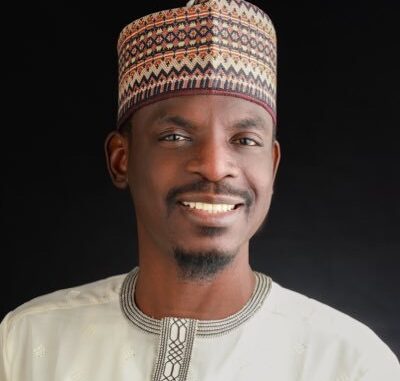
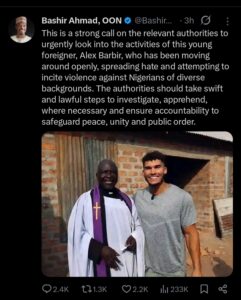
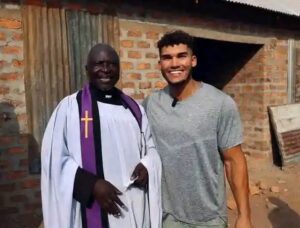
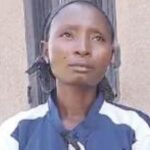
Bashir Ahmad, a former digital communications aide to ex-President Muhammadu Buhari, has called on Nigerian authorities to investigate American missionary Alex Barbir for allegedly inciting violence. Barbir had publicly spoken out against the coordinated attacks on Christian communities in Plateau State on Palm Sunday, March 29, 2026, and advocated for the right of affected communities to defend themselves. A photo accompanying the post showed Barbir standing alongside a local priest, an image Ahmad used to frame the missionary as a foreign agent stoking division on Nigerian soil.
The attacks that prompted Barbir’s comments were devastating. On Palm Sunday, gunmen carried out coordinated raids on villages in Jos North, Plateau State, killing Christians in what has been widely described as one of the most violent episodes in the region’s recent history. Casualty figures vary across reports, ranging from ten to fifty-four dead depending on the source. Local media and international monitoring organisations including Genocide Watch have documented the assault, with multiple accounts identifying the attackers as Fulani militants. The victims included women, children, and worshippers marking one of the most sacred days on the Christian calendar.
Ahmad’s intervention shifted the public conversation in a direction that many found deeply troubling. Rather than addressing the killings, the identity of the attackers, or the security failures that allowed the assault to happen, his statement focused on a foreign national who had spoken in defence of the victims. The call to investigate Barbir was framed around concerns about incitement, but critics immediately noted that the loudest demand for accountability was being aimed not at those who carried out the massacre but at someone who condemned it.
Reactions split sharply and predictably along religious and regional lines. From the north, particularly among voices aligned with Ahmad’s political circle, the sentiment echoed his position. Barbir was characterised as an outsider meddling in Nigerian affairs, and his advocacy for Christian self-defence was recast as a provocation that could deepen an already volatile situation. Calls for his arrest or deportation gained traction within that segment of the conversation.
From the south and among Christian communities nationwide, the response was furious. Users accused Ahmad of breathtaking hypocrisy, pointing out that his years of proximity to power under the Buhari administration coincided with a period during which attacks on farming communities in the Middle Belt escalated dramatically with little visible consequence for the perpetrators. The accusation was blunt and repeated across hundreds of replies. Dozens of people were butchered on Palm Sunday and the former presidential aide’s priority was silencing the man who spoke up about it.
The broader pattern is impossible to ignore. Plateau State has been a killing ground for years. Ethno-religious violence rooted in farmer-herder conflicts, land disputes, and identity politics has claimed thousands of lives since 2015. Communities are attacked, survivors bury their dead, government officials issue statements, and the cycle resets. Organisations like Genocide Watch have raised alarms repeatedly, but the international attention has never translated into sustained protection on the ground…..See More





Leave a Reply