
The Vatican’s call for nuance exposes how foreign lobbyists have turned faith into an instrument of politics.
By O’tega Ogra
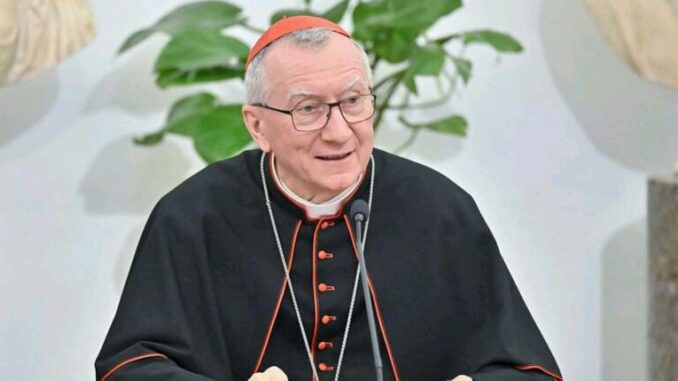
Cardinal Pietro Parolin’s remarks on Nigeria’s violence were calm and factual, yet they disrupted an entire industry of outrage. His insistence that the crisis is social, not religious, has revealed how global lobbying is reshaping Nigeria’s story for profit.
⸻
Cardinal Pietro Parolin’s recent comments on Nigeria’s violence did not make headlines because they were loud. They made them because they were true. At the Rome launch of Aid to the Church in Need’s 2025 Religious Freedom Report, the Vatican Secretary of State described the conflict tearing through Nigeria as a social crisis, not a holy war. He said extremist groups make no distinction between Christians and Muslims, and that many Muslims are themselves victims of the same violence. It was a simple statement, yet it challenged months of foreign storytelling that has cast Nigeria as a nation at war with its faiths.
Inside Nigeria, Parolin’s words resonated with those who live the consequences of the conflict. Reverend Joseph Hayab, chairman of the Christian Association of Nigeria in Northern Nigeria, said that the killings have long since crossed religious lines. “These terrorists moved beyond just killing Christians and started killing virtually everybody,” he said. “Mosques have also come under attack, and they kill Muslims who do not agree with them.”
From the Muslim community, the Sultan of Sokoto, Alhaji Muhammad Sa’ad Abubakar III, has repeatedly cautioned that there is no genocide against any group in Nigeria. He warned that careless language and imported labels could inflame tension and undo years of interfaith peacebuilding. Professor Khalid Aliyu, Secretary General of Jama’atu Nasril Islam, has said the same that criminals should be treated as criminals, not as representatives of any faith. Together, they paint a picture more complex than the one exported abroad.
Marta Petrosillo, author of Aid to the Church in Need’s Religious Freedom Report whose report was used by some lobbyist to counter the Cardinal, later clarified that Parolin’s comments had been taken out of context. In her interview on EWTN, she said Cardinal Parolin’s speech was one of the strongest defences of religious freedom, and it also recognised the layered social and economic causes of Nigeria’s insecurity. The report itself recorded violations across faiths, noting that both Christians and Muslims who reject extremist ideology are being targeted.
That nuance, however, was quickly drowned out in Washington. For months, lobbyists tied to the self-styled Biafra Republic Government-in-Exile an affiliate of the proscribed IPOB began citing Nigeria as a country persecuting Christians. Public filings under the U.S. Department of Justice show that Moran Global Strategies is registered to represent that group. Its leader, Simon Ekpa, was convicted in Finland this year for terrorism-related offences linked to deadly attacks in Nigeria’s southeast mostly against christians. Yet, in Washington, the same network funds lobbying efforts under the banner of religious freedom and self-determination.
Documents filed under the U.S. Foreign Agents Registration Act describe the firm’s mission as advocacy for human rights. Those words now appear almost verbatim in congressional briefings from US congressmen including Senator Ted Cruz of Texas who is said to have met with the group’s representatives, and press statements. The pattern is unmistakable: a proscribed group using paid lobbying to recast its armed campaign against Christians as a moral crusade for christians. By turning terrorism into advocacy, it becomes easier to attract sympathy, funding, and foreign political cover.
Independent data from the Armed Conflict Location and Event Data Project show that over seven thousand Nigerians were killed in violent incidents in the past year. That is about 319,000 deaths less than the number of those killed by gun violence in the US in 2025 alone. The dead in Nigeria include Christians, Muslims, and those of no faith. Most attacks were driven by local resource disputes, criminal gangs, Sahel terrorism and manipulation. To call that a “Christian genocide,” as some lobby groups like MGS do, is to erase the wider truth of shared suffering.
The Vatican’s message, far from political, was moral. It called for empathy without distortion. Nigerian faith leaders have made the same appeal. Across Plateau, Kaduna, and Niger States, Christian and Muslim groups continue joint peace initiatives, rarely noticed by the international press. Their work is slow and human, grounded in community rather than ideology.
Those who profit from inflamed narratives have no patience for that kind of truth. They rely on foreign outrage to raise funds and on simplistic headlines to sustain relevance. In that economy, suffering becomes strategy, and faith becomes a tool of influence.
Cardinal Parolin’s statement was not a denial of persecution. It was a defence of proportion. Every life lost in Nigeria, be they Christian, Muslim, or otherwise, carries the same value. To frame the entire crisis as the persecution of one faith is to trade truth for convenience and compassion for politics. Nigeria’s conflict was never a holy war. It is a human one. And until the world learns to see it that way, the merchants of distortion will keep finding buyers. Read – More

Leave a Reply