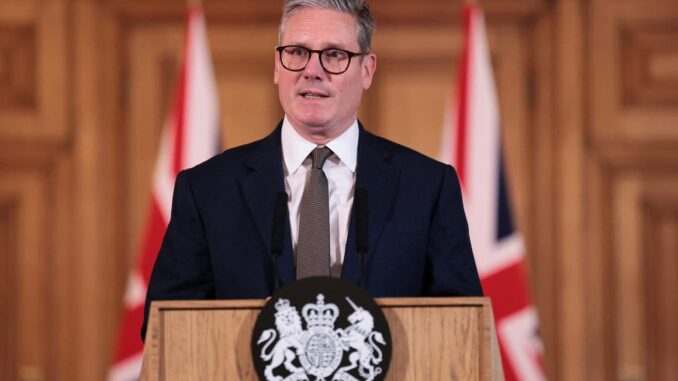
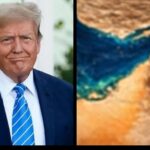
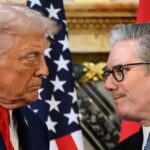
UK Prime Minister Keir Starmer has rejected British involvement in President Trump’s announced naval blockade of the Strait of Hormuz, stating that the United Kingdom is working with France, Spain, and other nations to form a coalition focused on protecting freedom of navigation and asserting that the United States cannot unilaterally dictate terms for the use of international waterways.
The statement, shared widely on social media, comes in response to Trump’s order for the US Navy to blockade all maritime traffic to and from Iranian ports starting April 13, 2026, a high-stakes escalation following the failure of US-Iran peace talks and months of conflict over the strategically critical waterway that carries roughly twenty percent of the world’s seaborne oil.
Starmer’s position marks a clear and public break with American policy on one of the most significant military and economic issues of the moment. A naval blockade of Iranian ports is an act of war under international law, and participation in such a blockade would place the UK in direct confrontation with Iran, a country that Britain has sought to engage diplomatically despite the broader US-led campaign of pressure and military action. By refusing to join the blockade and instead forming a coalition with France and Spain to protect freedom of navigation, Starmer is signaling that the UK views Trump’s approach as both legally and strategically problematic and that European powers are willing to act independently of Washington when American policy crosses lines that they are not prepared to cross.
The blockade order itself is extraordinary. Blockades are siege tactics designed to cut off a nation’s access to the sea, preventing imports and exports and imposing economic strangulation. They are acts of war, and they require enforcement through the threat or use of force against any vessel attempting to breach the blockade. Trump’s order to blockade all traffic to and from Iranian ports means that the US Navy will stop, board, or turn back ships regardless of their flag, cargo, or destination, a move that places American forces in potential confrontation with vessels from China, Russia, India, Turkey, and any other country that continues to trade with Iran despite US demands.
The choice of April 13 as the start date gives the international community and shipping companies a narrow window to decide how to respond. Ships currently en route to Iranian ports will have to divert, delay, or risk confrontation with US naval forces.
Countries that depend on Iranian oil or trade will have to choose between complying with the American blockade or challenging it, and the consequences of that choice could range from diplomatic friction to military incidents that escalate the conflict beyond Iran and the United States.
Starmer’s statement that the US cannot dictate terms is a direct challenge to American unilateralism and a reassertion of principles that have underpinned international maritime law for centuries. Freedom of navigation means that ships have the right to transit international waters without interference, and that no single nation, however powerful, can close a waterway or impose a blockade without international authorisation, typically through the United Nations Security Council….See More


Leave a Reply