An airstrike struck a weekly market on the Borno-Yobe border, killing fifty-six people, mostly traders, and hospitalising fourteen others, according to a report by Daily Trust shared by NigeriaStories.
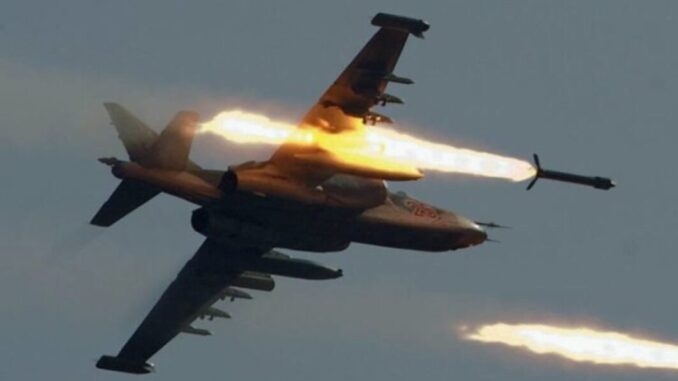
The incident, illustrated with an image of a military jet firing missiles, has triggered widespread grief and renewed questions about the accuracy of airstrikes in Nigeria’s northeast, where military operations against Boko Haram and ISWAP have been ongoing for over a decade and where civilian casualties from air raids have become a recurring and deeply contentious issue.
The market, which serves as a gathering point for traders from surrounding communities, was filled with vendors and customers when the strike occurred, turning what should have been a routine day of commerce into a scene of death and destruction.
The details of who conducted the airstrike and why the market was targeted have not been fully disclosed or verified. Nigeria’s military operates aircraft in the northeast as part of counterinsurgency operations, and airstrikes are a regular component of the campaign against insurgent groups that control or contest large areas of Borno, Yobe, and Adamawa states.
The problem is that distinguishing between insurgent gatherings and civilian markets from the air is difficult, and the consequences of errors are catastrophic. Fifty-six people are dead not because they were insurgents but because they were in a market at the wrong time, and whether that market was targeted intentionally, mistakenly identified as a militant gathering, or struck due to intelligence failure is a question that families of the victims deserve to have answered.
The image of a military jet firing missiles, while illustrative rather than documentary, reinforces the association between state military action and civilian death. Airstrikes are supposed to be precision tools, guided by intelligence and conducted with care to minimise collateral damage. The reality in Nigeria’s northeast has often been different. Markets, schools, mosques, and residential areas have been hit in previous incidents, with military authorities typically attributing the strikes to faulty intelligence, the presence of insurgents among civilians, or the difficulty of conducting operations in areas where militants blend into the population. The explanations do not bring back the dead, and they do little to address the anger and mistrust that builds each time civilians are killed by the forces that are supposed to protect them.
The fact that fifty-six people were killed in a single strike on a market suggests either that the market was densely packed, which weekly markets in rural Nigeria typically are, or that the munitions used were powerful enough to cause mass casualties across a wide area. Either way, the death toll is among the highest from a single airstrike incident in the northeast in recent years, and it places this event in a category of tragedies that demand investigation, accountability, and changes to targeting procedures to prevent recurrence….See More





Leave a Reply