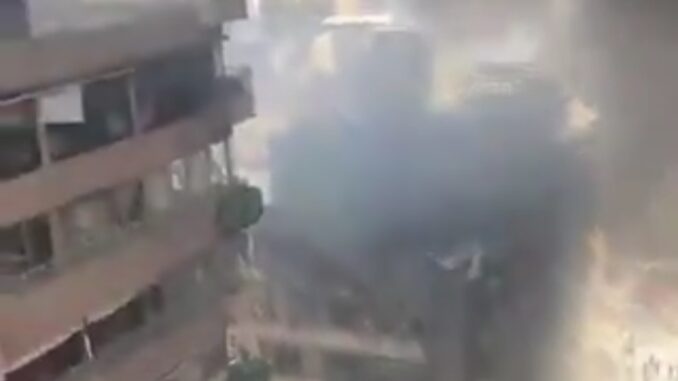
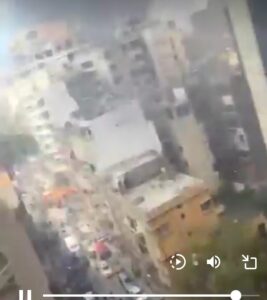
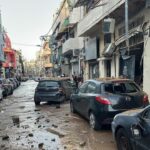
High-angle video footage from Beirut shows thick plumes of smoke rising from heavily damaged multi-story buildings, streets littered with debris and wrecked vehicles, and visible fires spreading through urban areas following what Israeli officials described as the largest strike on Lebanon since the current phase of the conflict began.
The operation targeted Hezbollah infrastructure in Beirut’s southern suburbs, known as Dahieh, a densely populated area that has long been a stronghold of the Lebanese militant group and political party.
The strike, conducted in April 2026, killed at least a dozen people including civilians and added to the mounting toll from repeated Israeli airstrikes across Beirut and southern Lebanon in recent weeks.
The footage, shared by BRICSinfo, captures the immediate aftermath of the attack. Smoke obscures entire blocks, fires burn unchecked in residential and commercial buildings, and the streets are impassable, choked with rubble from collapsed structures and the twisted remains of vehicles caught in the blast zones.
Emergency responders and residents can be seen moving through the chaos, but the scale of the destruction suggests that rescue and recovery efforts will take days if not weeks, and that the casualty figures currently reported are likely to rise as more bodies are recovered and the injured succumb to wounds sustained in the attack.
Israel’s framing of the operation as its largest strike in Lebanon is significant. It signals an escalation in the intensity and scope of military action against Hezbollah, moving beyond targeted strikes on individual commanders or weapons depots to large-scale bombardment of infrastructure and facilities that Israel claims are used for military purposes but which are embedded in civilian neighbourhoods. The justification provided by Israeli officials is that Hezbollah uses civilian areas to shield its operations, making it impossible to strike the group without risking civilian casualties. Critics counter that the scale of destruction and the number of civilian deaths indicate that the strikes are either reckless in their disregard for proportionality or deliberately punitive, designed to impose collective costs on communities that support Hezbollah.
The timing of the strike is also notable. The attack occurred despite earlier ceasefire arrangements that were supposed to de-escalate hostilities along the Israel-Lebanon border and create space for diplomatic efforts to address the underlying tensions between Israel and Hezbollah. Those ceasefires, much like the two-week truce between the US and Iran that collapsed within hours, have proven fragile and short-lived. Violations are frequent, blame is mutual, and the pattern is one of temporary pauses followed by renewed and often intensified violence….See More


Leave a Reply