

Picture Illustration Purposes
A quote by Nigerian commentator Chisom Agbafor has struck a nerve across social media, stating that men are not afraid of love but of the responsibility that love is often disguised as, where entering one relationship can quickly turn into solving a partner’s unresolved financial problems fast enough to bankrupt a person more efficiently than a bad investment.
The statement, shared widely and accompanied by strong agreement in the replies, captured a sentiment that many Nigerian men have been expressing privately for years but rarely voice publicly with this level of clarity.
The response from mostly male Nigerian users was immediate and emphatic. Commenters described modern relationships as transactional and monetized, with the struggling economy turning what should be emotional partnerships into financial obligations that feel less like companionship and more like costly subscriptions with no option to cancel. The metaphor of a subscription service resonated strongly, reflecting a generation of men who feel that committing to a relationship means signing up for expenses they cannot predict and responsibilities they cannot escape.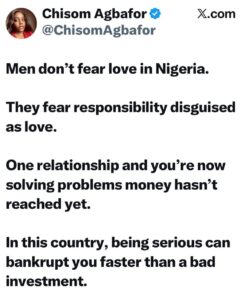
At the heart of the conversation is a cultural expectation deeply embedded in Nigerian society. Men are traditionally expected to be primary providers, a role that extends beyond their partner to include in-laws, extended family, and sometimes entire networks of dependents who see the man’s income as communal rather than individual. In a functional economy with stable employment and predictable costs, that expectation is difficult but manageable. In Nigeria’s current economic climate, where inflation sits above thirty percent, unemployment is widespread, and even salaried workers struggle to meet basic needs, the expectation becomes crushing.
The replies painted a consistent picture. A man enters a relationship with one person and quickly discovers he is now responsible for rent arrears, medical bills, school fees for younger siblings, household groceries, and a list of emergencies that never seems to end. What began as love turns into a second job, one that pays nothing and demands everything. The resentment builds not because the man does not care but because the weight becomes unbearable and the line between partnership and exploitation becomes impossible to see.
Women in the replies pushed back, noting that Nigerian women are also struggling and that many relationships involve mutual support rather than one-sided dependency. They argued that framing commitment as financial victimhood ignores the emotional labor, domestic work, and caregiving that women contribute, often without recognition or compensation. The expectation that men provide financially, they noted, exists alongside the expectation that women sacrifice career advancement, personal freedom, and sometimes safety to maintain the relationship and the household.
The debate revealed a deeper fracture in how Nigerian men and women are experiencing the economic crisis. Both sides are under pressure, but the nature of that pressure differs. Men feel financially drained. Women feel emotionally unsupported and economically vulnerable. Both are correct, and both are responding to a system that places impossible demands on relationships while offering no safety net when those demands become too much to bear.
The broader issue is that relationships in Nigeria have become sites of survival rather than sites of joy. When basic needs are unmet and formal systems of support are absent or inaccessible, romantic partnerships become makeshift welfare programmes. Love is expected to fill the gaps left by the absence of jobs, healthcare, affordable housing, and social security. And when love is asked to do all of that, it often breaks under the weight.
The caution Nigerian men express toward serious relationships is not entirely about fear of responsibility. It is about fear of drowning. It is about recognising that the moment you say yes to a relationship, you are also saying yes to a list of obligations that grow faster than your income and last longer than your emotional reserves. The economy has turned commitment into a liability, and until that changes, the hesitation will remain.
Chisom Agbafor’s quote went viral because it named something that many people feel but few are willing to say out loud. Nigerian men are not afraid of love. They are afraid of bankruptcy disguised as love, and in a country where survival is already a full-time job, that fear is entirely rational….See More






Leave a Reply