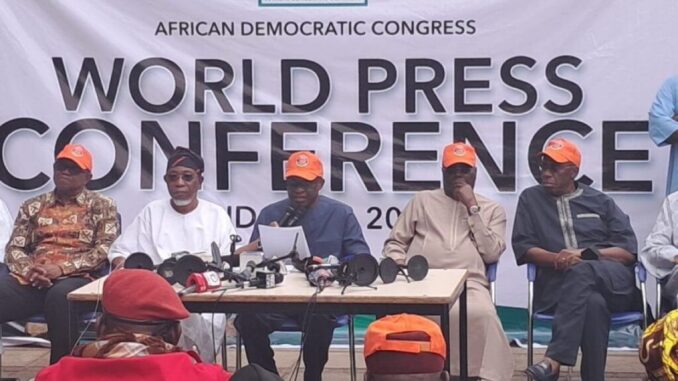
The African Democratic Congress has publicly demanded the removal of the Independent National Electoral Commission chairman, Professor Joash O. Amupitan, accusing him of involvement in what the party describes as a deliberate plot to enforce a one-party state by destabilising opposition parties. The demand, made at a press conference, represents one of the most direct attacks on INEC’s leadership by an opposition party in recent memory and raises questions about the commission’s neutrality ahead of the 2027 general elections.
According to the ADC, the push for Amupitan’s removal is rooted in what it claims is APC-orchestrated pressure on INEC to interfere with the internal affairs of opposition parties. The accusation comes against the backdrop of the ADC’s own leadership crisis, which involves rival factions including one associated with former Senate President David Mark. The party alleges that rather than allowing it to resolve its internal disputes through its own constitutional processes, INEC has taken sides under external influence, effectively undermining the party’s ability to function as a credible political entity.
The ADC further claimed that threats of arrest featured in correspondence related to the leadership dispute, suggesting that the crisis has moved beyond political manoeuvring into what the party considers outright intimidation. While the specific details of these threats were not fully laid out in public, the allegation paints a picture of an opposition party that believes the institutional machinery meant to protect democratic competition is being weaponised against it.
INEC has not publicly responded to the accusations at the time of reporting. The commission, which is constitutionally mandated to organise elections and regulate political parties, has long faced questions about its independence. The INEC chairman is appointed by the president, a structural arrangement that critics argue makes true neutrality impossible regardless of who occupies the position. Every election cycle produces accusations of bias, and every INEC chairman eventually faces calls for removal from one aggrieved party or another. The question is always whether the complaint reflects genuine institutional failure or political desperation.
Reactions on social media reflected that familiar scepticism. Many users acknowledged the ADC’s concerns but questioned whether the party’s real problem is INEC interference or its own inability to manage internal divisions. Leadership crises within Nigerian opposition parties are common, and factionalism has destroyed more political movements than any external plot ever could. Some commenters argued that blaming INEC for internal dysfunction is easier than accepting responsibility for a fractured house.
Others took the accusations more seriously. Users pointed to a broader pattern of opposition parties struggling to maintain coherence under what they described as sustained pressure from the ruling party’s machinery. The argument is that the APC does not need to win every election fairly if it can ensure that opposition parties arrive at the ballot too divided, too broke, or too legally entangled to compete effectively. Whether or not INEC is actively complicit in that strategy, the perception alone is damaging to the electoral process.
The timing of the ADC’s demand adds urgency to the conversation. With the 2027 elections approaching, the credibility of INEC is not an abstract governance question. It is the foundation on which public trust in the entire democratic exercise rests. If opposition parties believe the umpire is compromised before the game begins, the legitimacy of whatever result emerges will be contested before the first vote is cast…..See More







Leave a Reply