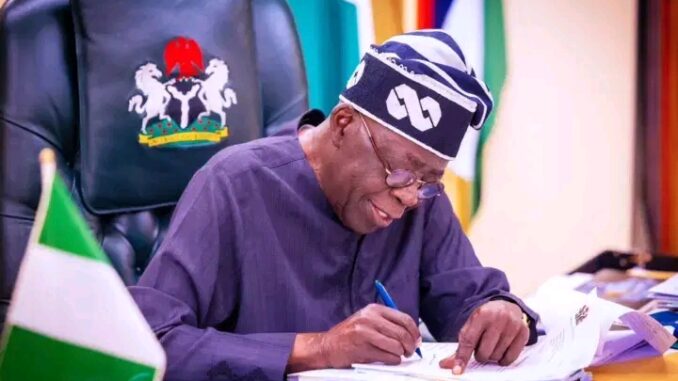
President Bola Ahmed Tinubu has written to the Senate seeking approval to borrow a total of six billion dollars in new loans from two foreign financial institutions. The request, contained in two separate letters read during plenary on Tuesday by Senate President Godswill Akpabio, asks for five billion dollars from Abu Dhabi Bank and one billion dollars from London Citi Bank. If approved, the loans would represent one of the largest single borrowing requests by any Nigerian president in recent memory.
The five billion dollar facility from Abu Dhabi Bank is intended to cover the federal government’s budget deficit and debt financing obligations. The request acknowledges what has been evident for years. Nigeria’s revenue cannot keep pace with its spending, and the gap continues to be filled with borrowed money. Each new loan adds to a national debt profile that already runs into tens of trillions of naira, with debt servicing consistently consuming a larger share of government revenue than capital expenditure or social spending.
The second letter seeks approval for a one billion dollar loan from London Citi Bank, designated specifically for the rehabilitation of port infrastructure. According to the president, the funds would be directed toward the Lagos Port complex and Tin Can Island Port, with stated objectives including addressing critical deficiencies, improving operational efficiency and safety standards, supporting non-oil trade diversification, and positioning Nigeria as a regional trade hub.
“The project’s objectives are to address critical deficiencies, improve efficiency, improve safety standards, support non-oil trade diversification and position Nigeria as a trade hub,” the letter read.
Akpabio referred both letters to the Senate Committee on Local and Foreign Debts, chaired by Senator Aliyu Wammakko, with instructions to carry out the necessary legislative review and report back immediately. The speed of the referral suggests the administration is keen to secure approval without prolonged legislative debate.
The port rehabilitation component, on its surface, carries a stronger justification than the broader deficit financing request. Nigeria’s ports have been plagued by congestion, inefficiency, and outdated infrastructure for decades. The cost of doing business through Lagos ports remains among the highest in West Africa, driving importers and exporters toward neighbouring countries and undermining the government’s stated goal of boosting non-oil revenue. If the one billion dollars is deployed effectively and transparently, the investment could yield returns that justify the borrowing.
The five billion dollar request is harder to defend with the same confidence. Budget deficit financing through external borrowing is not inherently problematic, but it becomes so when it follows a pattern of borrowing without corresponding improvements in revenue generation, public service delivery, or economic productivity. Nigeria has borrowed heavily under successive administrations, and the results visible to ordinary citizens remain difficult to reconcile with the figures on the loan documents.
The national debt has grown steadily under Tinubu’s administration, continuing a trend that accelerated under his predecessor. Each borrowing cycle comes with assurances about investment, returns, and fiscal responsibility. Each cycle also leaves the next generation of Nigerians further indebted to foreign creditors whose terms and conditions are rarely subjected to meaningful public scrutiny before approval is granted.
The Senate’s role in this process is constitutionally significant but historically predictable. Legislative approval for presidential borrowing requests has rarely been withheld, regardless of the amount or the stated purpose. Whether the Wammakko-led committee will subject this request to rigorous scrutiny or simply fast-track approval as instructed will say a great deal about whether the legislature views itself as a check on executive spending or a rubber stamp for it.
Six billion dollars is not a small figure. How it is spent, who benefits, and what Nigerians are left to repay will determine whether this borrowing was an investment in the country’s future or another entry in a growing ledger of debt that the nation’s children will inherit without ever being consulted…..See More



Leave a Reply