
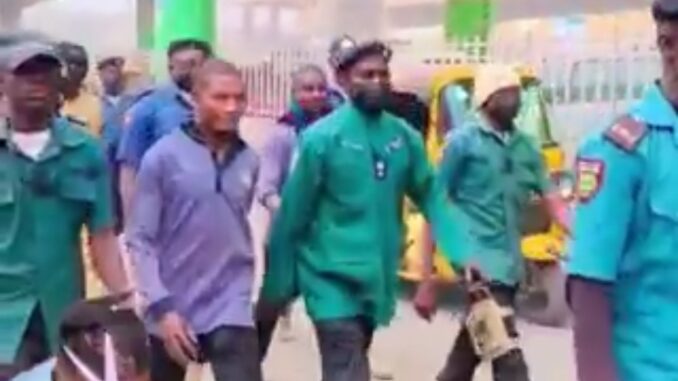
Video footage circulating on social media shows officers of Kano State’s Hisbah corps forcibly cutting the hair of young men during the March 2026 Sallah celebrations. The operation, branded “Kauda Da Badala,” targeted what the agency described as indecent dressing and inappropriate hairstyles. According to reports by Sahara Reporters and other local outlets, over five hundred young men were subjected to the exercise, many of them restrained while their hair was shaved off in public.
The clips show groups of young men seated or held in place as Hisbah officers work through them with clippers. There is no consent being sought. There is no process beyond identification, seizure, and shaving. The operation was carried out during one of the most important celebrations on the Islamic calendar, a period when young people across the north dress up, socialise, and mark the occasion with family and friends. For hundreds of them, the celebration was interrupted by uniformed men with clippers and a mandate they did not agree to.
Hisbah was established following the adoption of Sharia law across twelve northern Nigerian states beginning in the year 2000. The agency is tasked with enforcing moral codes derived from Islamic principles, covering areas including dress, alcohol consumption, and social behaviour. Over the years, its operations have included raiding bars, confiscating alcohol, and policing interactions between unmarried men and women. The forced haircuts during Sallah are the latest in a long line of enforcement actions that consistently provoke national debate.
The reaction online was overwhelmingly critical. Commenters described the operation as archaic, humiliating, and a clear violation of individual rights. Many questioned the logic of deploying state resources to police hairstyles while Kano and the broader northern region face far graver challenges. Banditry continues to ravage communities across the northwest, kidnapping remains a daily threat, and unemployment among young people in the north is staggering. World Bank data places poverty rates in northern Nigeria above seventy percent, a figure that makes the spectacle of state agents chasing young men over haircuts feel not just misplaced but offensive.
Several users pointed to the constitutional tension that Hisbah has always embodied. Nigeria operates as a secular federation under its 1999 constitution, which guarantees fundamental rights including freedom of expression and personal liberty. The enforcement of religious moral codes by a state-funded agency sits uncomfortably against those guarantees, particularly when the enforcement involves physical force against individuals who have committed no criminal offence. Legal challenges to Hisbah’s authority have surfaced repeatedly over the years, but the agency continues to operate with the backing of state governments that derive political value from its existence.
Defenders of the operation, though fewer in the replies, argued that Hisbah is fulfilling its mandate within a system that the people of those states chose through their elected representatives. They maintained that moral guidance is part of the social contract in Sharia-practising states and that the agency’s work reflects community values rather than external imposition…..See More


Leave a Reply