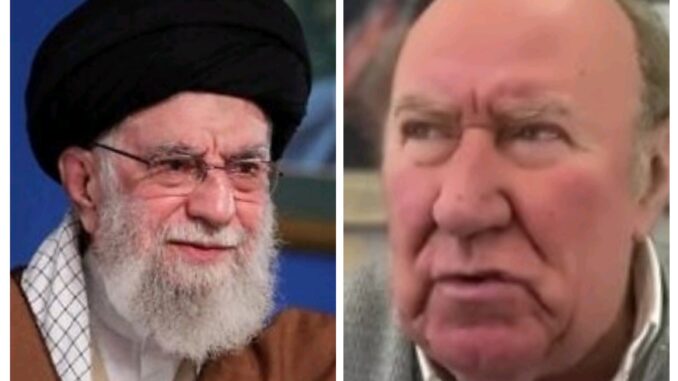
The American military posture now assembled in the Gulf region represents something categorically different from previous shows of force against Iran — a sustained, multi-dimensional campaign capability rather than a short-term pressure tool — according to British political analyst Andrew Neil, who warned that the distinction carries profound implications for what may be imminent.
Speaking on Times Now, Neil pushed back firmly against the interpretation, advanced by some analysts, that the buildup is primarily a bargaining instrument designed to bring Tehran back to the negotiating table with greater urgency. While he acknowledged that diplomatic talks remain active, Neil argued the physical reality on the ground tells a different story.
“If it’s simply a bargaining tool, it’s overkill,” he said, “because it is an enormous buildup.”
The critical point for Neil was not merely the size of the assembled force, but its character. Previous American military action against Iran — most notably strikes conducted the prior summer — had been discrete, time-limited operations: a single wave of attacks, executed and withdrawn. The current configuration, he argued, has been designed with an entirely different operational purpose in mind.
“This is a buildup to sustain an attack on Iran by multiple means over a long period of time,” Neil said, making clear that the infrastructure in place goes well beyond what would be necessary for another limited strike.
He noted that the capability now positioned in the theatre gives the United States genuine operational flexibility — the ability to act at a time and scale of its choosing. Yet he was candid that whether President Trump will ultimately authorise such action remains uncertain. What is no longer uncertain, in Neil’s view, is that the option exists in fully executable form.
Neil also raised the diplomatic dimension with notable scepticism. Talks between Washington and Tehran are due to resume, but he cautioned against placing excessive faith in that process, describing Iran as a negotiating partner with a long history of using dialogue to delay rather than resolve.
“Dangerous dealing with Iran on talks,” he said, “because they tend just to string you along — as President Obama found out.”
His broader concern, however, transcended the tactical question of timing. Neil argued that the most troubling gap in the current American strategy is not military but political — specifically, the failure to publicly define what success looks like. Is the objective the permanent elimination of Iran’s nuclear programme? The degradation of its missile capacity? Or regime change altogether?
“We do not know what the objectives are — what is hoped to be achieved by a military attack,” Neil said, adding that this ambiguity makes it impossible to assess whether any military action, however powerful, would constitute a genuine strategic victory.
Without that clarity, he concluded, even the most formidable military buildup in the region carries within it the seeds of a deeper and more dangerous failure…..See More




Leave a Reply