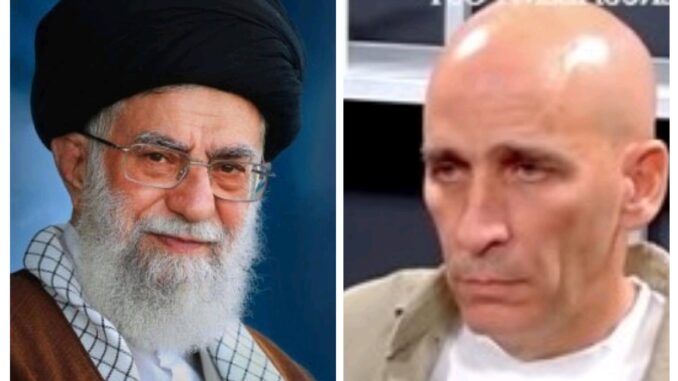
Retired Israeli Air Force Major General Tal Kelman delivered a stark assessment of Iran’s priorities, stating that the regime in Tehran is “investing millions of dollars not on its people but on its proxy forces and on its ballistic missile capability.” The comments came during an interview with the Jerusalem Post’s Defense and Tech podcast, where Kelman drew on nearly 40 years of military experience to analyze regional threats.
Kelman, who served as head of the J5 strategic planning and cooperation directorate in the IDF general staff, emphasized that the fundamental problem facing Israel and the West is not merely Iran’s nuclear program or missile capabilities, but the nature of the regime itself. “The core problem is the very extreme fundamentalist regime that now controls Iran,” he explained, noting that he has been consistent in this assessment throughout his years dealing with Iranian threats.
The retired general pointed out that Israel maintained relationships with Iran until 1979, and stressed that there is no inherent conflict with the Iranian people. “I think actually with a different regime there can be amazing cooperation and relationships between Israel and Iran,” Kelman said, highlighting the potential for both countries as advanced nations in technology and industry.
However, the current regime’s actions speak louder than its declarations. “It’s not only declarations, it’s also actions that it wants to destroy Israel,” Kelman stated, emphasizing the regime’s dedication to funding proxy forces across the region rather than improving conditions for Iranian citizens.
Kelman outlined what he believes should be the international strategy moving forward: “We need to find ways to weaken, restrain this regime and basically improve the conditions for in the future a regime change.” He acknowledged that achieving regime change would be extraordinarily difficult, noting that Iran’s Islamic Revolutionary Guard Corps (IRGC) comprises two million people and serves as the strongest organization in the country, effectively preventing any organized opposition from rising.
The major general expressed skepticism that military force alone could topple the Iranian regime, but suggested it might influence the Iranian population. “At the end of the day, it needs to happen from within,” he said, while admitting he’s not sure such change will happen in the near future.
Despite this uncertainty, Kelman maintained that regime change remains “the most important thing that needs to happen to have a positive Middle East.” He described the current regional situation as cards thrown in the air, with the potential to fall into either a similar configuration as before October 7th or create an entirely new Middle East—if Israel, in close coordination with the United States, plays its cards correctly…. see More







Leave a Reply